
She Built an AI Memory Layer Without Being a Developer

I'm a marketer who wrote ten lines of Python and gave up. Then I got so tired of re-explaining myself to AI agents that I built them a memory, and learned that the people who feel a problem most can now build the fix.

By Alex Greenshpun

On SyntaxGTM with Tom Granot.

Last updated on

  • 9 min read
  • 6 parts
  • 6 drawings to play with
Watch on YouTube
In this essay6 parts
  1. 01Big confession: I am not a developer
  2. 02I got tired of re-explaining myself
  3. 03The day a memory tool broke my whole setup
  4. 04Memory that maintains itself and costs almost nothing
  5. 05Try, fail, benchmark
  6. 06Now we can
  7. ··Key moments
  8. ··Full transcript

The most code I have ever written by hand is about ten lines of Python, and I gave up on those in 2018. Today I run Total Recall, a memory layer for AI agents that I designed and built, and it sits behind every agent I work with, remembering what we did, what I decided and why. Tom Granot spent 15 to 18 years as an engineer living in the terminal, and Total Recall became a real part of his own memory layer before he even sat down to review it on his channel, SyntaxGTM.

I don't think my story is a fluke. People who live with a problem every day, and know their field better than anyone, can now build the fix themselves, all the way down at the infrastructure level. Memory was my problem, so memory is where I started.

My entire coding career. Ten lines of Python, back in 2018.

Big confession: I am not a developer

I'm a marketer by trade, with 15 years in the job, and my whole coding career before AI fits in one sentence.

I think the most lines of code I have ever written was about ten lines of Python, when I attempted to learn Python somewhere around 2018, and I gave up.

About a year before this conversation I was VP Marketing at a startup working on AI and data, watching the technology move so fast that following it from the side stopped feeling like an option. So I said, you know what, the hell with it, and quit my job. I didn't want to be behind, and I knew I had to learn this thing for real.

I started building my own MCPs, my own tools and agents, you name it. I also started a community in Israel for marketers working with AI, and began working with companies on AI transformation and implementation, the work I now do at 10x Company with my partners Noy Rubinstein and Hadar Yakir. Almost all of it, the client work included, ran through AI agents, which is how I ran straight into their biggest weakness.

Every new chat, I had to tell the whole story again.

I got tired of re-explaining myself

Agents forget. Every new session starts from zero, so the agent doesn't know which client you mean, what you tried last time or why you chose one approach over another, and you end up explaining it all again, then again the next day. We always joke that AI gives us all a kind of ADHD, and I already had that feeling, with so many projects running at once and so much to keep track of. Re-explaining myself to my own tools on top of all that wore me out.

What I wanted was a partner. I wanted to open a blank chat and say, "Hey, remember what we did with that client, with that workshop? Can you do that thing, but for this other client?" and have it just know. A partner like that changes what I can hand over, too. Once an agent remembers the context, it can run longer tasks and more intricate loops, and I only step in when my opinion is truly needed.

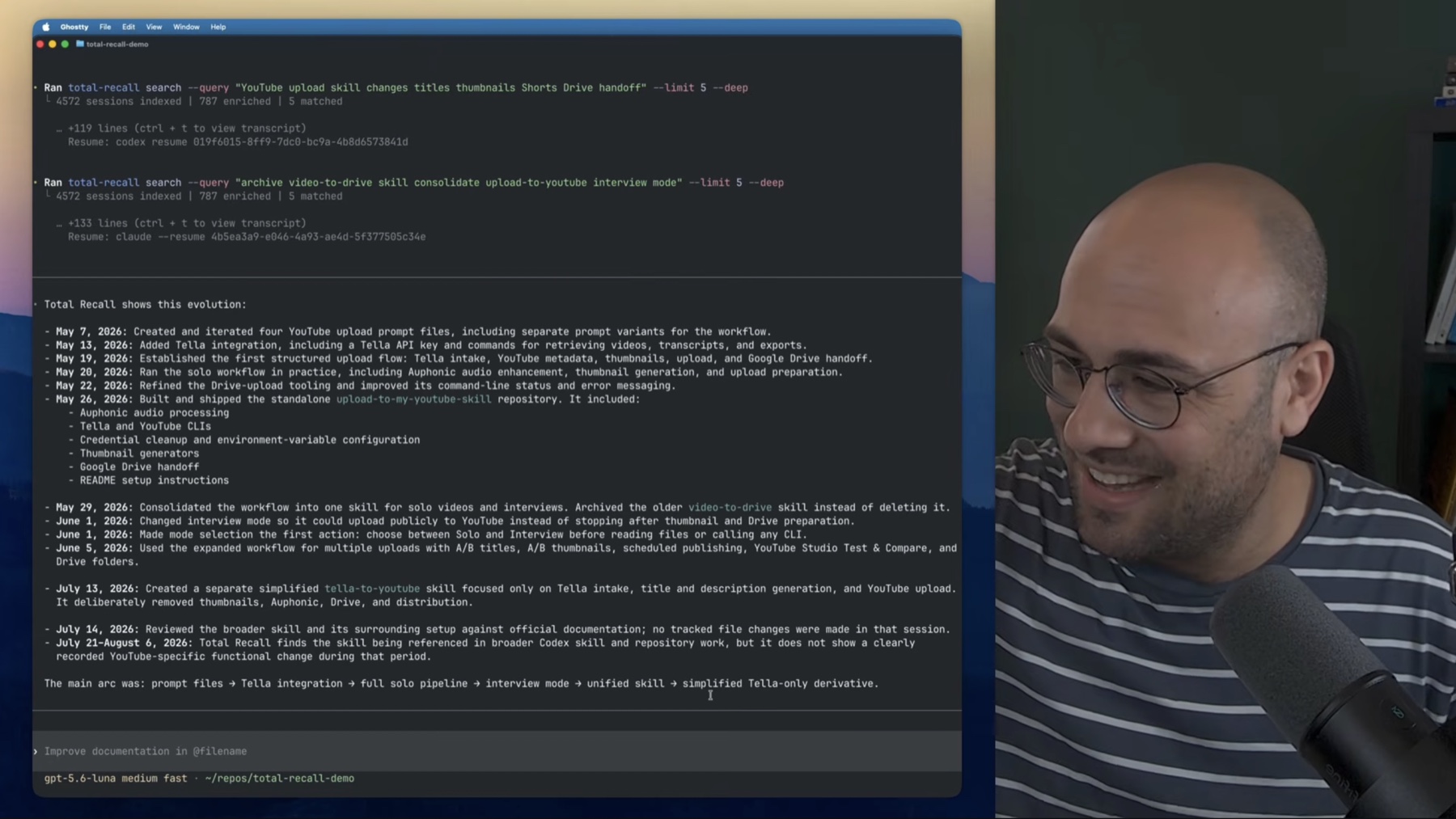
Tom named the missing piece precisely. Every session holds two kinds of material, what the AI produced and the human input you gave it along the way, meaning your instructions, your reasoning and your decisions. In his view, the question Total Recall answers is what you told the AI while you worked, and that human input is exactly the part you end up repeating. When Tom opened a new folder and told his agent what he wanted to build, Total Recall went and found everything he had said in earlier sessions about similar work, and used it to scaffold a plan for the next round. I get the same feeling every day, and the best part is that it happens without being asked. I never have to tell my agent, "Hey, go use this tool, open this MCP server." It goes and does its thing.

Getting to that feeling took a long detour through other people's memory tools, and one of them nearly cost me my whole setup.

One install, one black screen of death, one very sweaty day.

The day a memory tool broke my whole setup

Building a memory layer was never the plan. I'm a marketer, and writing code isn't my thing. So my first move was to find one. The open-source community is amazing, and I assumed someone had solved this already. I went to GitHub and tried a couple of smaller tools, and they didn't really work. I tried building memory in Obsidian, and that didn't do it for me either. I tried the LLM wiki idea Andrej Karpathy talks about, a knowledge base the AI keeps in plain files, and it's good, but it wasn't the kind of memory I wanted.

Then I tried claude-mem, one of the biggest stars among AI memory tools, and it broke my entire Claude setup. I work only in my terminal, and the minute after I installed it, I opened a new Claude session and got a black screen of death. I tried again, and again nothing happened.

I spent the entire day on a hunt to save my setup. Thank God I do backups, so everything was back by the end of the day, but I was sweating, and I decided I wasn't taking my chances like that again. If the memory I wanted didn't exist in a form I could trust, I would build it myself.

Memory that maintains itself and costs almost nothing

Once I decided to build, the first question was what to build differently. Anyone who asks about my business plan raises the same worry: memory for AI is a huge red ocean, and every time you blink there are ten new players. It's true, and I'm fine with it. Since I started building, I've studied a lot of those tools to see how they think, and two problems kept showing up.

The first is maintenance. Almost all of them need you to keep the memory organized before your agent can remember anything, even the advanced ones with complex AI workflows built in. You have to work inside the right folder, keep everything up to date, and make sure the relevant information sits at the top. With time you become the maintainer of your own knowledge and memory, or of the setup you created to maintain it. So I made Total Recall automated and proactive: it captures and organizes on its own, and the agent reaches for it when it needs to.

The second is cost. Many memory systems lean on an AI model to sort and search your memories, and every one of those calls burns tokens, the units AI providers bill you for every bit of text a model reads or writes.

I'm not a developer. I don't work at a company where I can spend thousands of dollars in API calls.

So I built Total Recall to be super efficient. All the indexing and searching happens in plain code, with zero LLM calls. When your agent searches its memory, the only tokens you pay for are the agent's own question. I compared it with a memory built from markdown files, like those LLM wikis, and Total Recall saves up to 97% of tokens versus markdown-based systems. Tom picked up on why that matters: people are used to treating context as a layer of intelligence, and they're only now starting to treat it as a layer of memory that has to be efficient too. In the middle of the token maxing craze, when companies brag about burning through tokens, I'd bet that a year from now that idea will look ridiculous.

Under the hood, Total Recall runs a hybrid search. It combines semantic search, which finds memories by meaning, with lexical search, which finds the exact words, plus a few other signals. People sometimes call it a new kind of RAG. There are some RAG mechanics in there, but the big difference is that Total Recall knows how to forget. Each memory gets weighed by how recent and how important it is, so the important ones come up front, while anything that shouldn't pop into context gets almost archived. Fewer searches go nowhere as a result. And the agent gets progressive disclosure, seeing a little at a time and opening the details only when they're needed. I love progressive disclosure so much that if I ever had a rock band, that would be its name.

Every one of these choices came out of the same process, and most of that process is failing.

Try, fail, benchmark

Search is a layered problem with a lot of players, so people often want to know how someone outside engineering makes those architecture calls. My process starts with research and a close look at existing solutions, especially the ones that failed me, because by the time I sat down to design anything I already knew what to avoid.

I think probably the most important thing in building a product is understanding what not to do.

From there I test, fail and test again, and I fail a lot, really. I'll try a local model to see how it runs, measure it, and move on when it doesn't hold up. Tom, who comes from engineering, recognized the loop: something broke, I dug into why, chose a different path and kept going until I hit the target I had set. He said it's very close to how he would approach the problem himself.

The target comes from academic benchmarks, standard exams any memory system can sit, which let me compare Total Recall with what big players like Mem0 have published. On LongMemEval, the leading memory benchmark, Total Recall scores 98% end to end with an AI model as the judge, 490 of 500 questions, so I'm pretty much killing it right now. Some people dismiss benchmarks altogether, and I get the instinct, because trust in AI tooling is low. But the benchmark is my answer to that. I ran the test, I got the result, and that result is the only claim I make.

Benchmarks tell me the memory works today. Where memory goes next is a bigger question, and it's about who owns it.

Totally local. Your memory lives on your machine, nobody else's.

Now we can

I think memory will soon be built into every agent and every harness you work with, and it will feel smooth. Whether the big companies let agents share that memory is less certain. Right now everyone is racing to beat everyone else, so we're in a very siloed stage, and your memory in one tool doesn't follow you into the next. Total Recall already works across them. It's the same memory for all your agents: talk to Codex, and Claude knows exactly what you discussed and why you made the decision you made. Eventually memory becomes basic infrastructure, and the models and agents run on top of it.

You also have to decide where your memory lives. The OpenAIs and Anthropics of the world can own that layer for you, or you can own it, and I think most of us would want to own it. So Total Recall is completely local and lives only on your machine. Maybe one day there will be a cloud version for people who prefer that, and even then the memory stays yours.

Tom keeps a list of 927 AI tools to review. He looked closely at about 120, and by his estimate around 15% of those were built by people who aren't trained engineers. He calls us people from the trenches, experts in our own field who end up building the tools we need, and who might come up with the idea no engineer thought of. I came from marketing, felt one problem every single day, and built the infrastructure to fix it, and I've done the same with Token Optimizer, an open source tool that has crossed 30K users in just a few months, and with Miss Chief, the little virtual assistant who helps me with a lot of my work. What made it possible was knowing the problem better than anyone, and knowing from the tools that failed me exactly what not to do. A few years ago, that wasn't enough for someone like me to build infrastructure.

Now we can.

Key moments

  1. 01:34"Big confession, I am not a developer": ten lines of Python, around 2018, then she gave up.
  2. 02:11Fifteen years in marketing, then "the hell with it," she quits her job to learn AI for real.
  3. 02:51Where Total Recall started: getting tired of re-explaining herself to agents.
  4. 05:57claude-mem breaks her Claude setup and costs her a full day.
  5. 11:32Zero LLM calls for search, and up to 97% fewer tokens than markdown files.
  6. 15:17The most important thing in building a product: knowing what not to do.
  7. 16:1798% end to end on LongMemEval, 490 of 500 questions.

Alex Greenshpun is an AI strategist and builder and co-founder of 10x Company. She builds Total Recall, Token Optimizer and Outsourcerer.

Read the full conversation

00:00Tom Hello, Alex.

00:00Alex Hi, Tom.

00:00Tom How are you?

00:00Alex I'm terrific. Thank you for having me.

00:00Tom For sure. Before we start, I want to talk a little about the background of this. Alex and I have been talking for a while about getting her on the channel. Alex is building a tool called Total Recall. We'll get to that in a moment. But more than that, she's a premier consultant, where we're from, for go-to-market AI. She does a lot of work with multiple companies: workshops, implementations, and other things like that. And on the side, she's building a set of tools for, let's say, the everyday [unclear: "competition"]. They're not specifically go-to-market tools. They're more general AI tools.

00:28Tom This is a weird interview, because unlike most of my sessions, where I do the tool review first and the interview after, we're recording this before the tool review. Why is this interesting? Usually the truth reveals itself to me after I do the tool review. Only once I sit down and actually play with the tool on camera do I know what I want to say about it. Total Recall has already become quite a significant part of my memory layer without me even doing the tool review, because, kind of like Familiar, which we talked about before, it just does its thing in the background and doesn't require a lot from me. It's just there. So I felt I had gotten enough value from the tool for this conversation, which is why Alex is here. So, without me speaking for three minutes about your tool: Alex, tell the audience a little about yourself, Total Recall, how it came to be, the whole shebang.

01:18Alex The whole shebang. Here you go. Thank you for having me again, Tom. By the way, I love your channel and what you've done with it. It's been amazing to see your growth, so kudos. A little bit about me. Big confession: I am not a developer.

01:34Tom No. Sorry, go ahead.

01:34Alex No, for real. I think the most lines of code I have ever written was about ten lines of Python, when I attempted to learn Python somewhere around 2018, and I gave up.

01:53Tom It's 2026, for anyone listening. So that's eight years ago. Go ahead.

01:53Alex Yeah. [laughter] Basically, I'm a marketer by trade. I've been doing marketing for 15 years now. About a year ago I decided, you know what, the hell with it, I'm going to quit my job. I was VP Marketing at a nice, interesting startup, which, by the way, was acquired by Nvidia recently. I quit my job and I said, you know what, this AI thing, I have to learn it for real. I have to figure it out, because I don't want to be behind, and I felt the progress was amazing. So I jumped in and started building my own MCPs, my own tools, agents, you name it. Then I also started running a community here in Israel for marketers working with AI, and started doing consulting, workshops, and so on. That's a little bit about me.

02:51Alex At the same time, working with those clients and doing a lot of this work with agents, at some point I started getting tired of re-explaining myself. We always say that AI causes almost an ADHD for us. It's kind of a thing. I already had this ADHD feeling: I have to do so many things at the same time and keep track of so many things, and I also have to re-explain myself again and again. I got tired of it.

03:30Alex So I said, well, maybe there's a tool out there. There's such an amazing community of open-source tools. The first thing I did was go to GitHub. I started exploring and tried a couple of smaller tools. They didn't really work. I tried doing this with Obsidian. That didn't really do it for me either.

03:48Tom The whole knowledge... what does Karpathy call it? The knowledge...

03:48Alex The LLM wiki.

03:48Tom The LLM wiki, yeah.

03:48Alex I tried it. It's good, but it's not really the type of memory I wanted. I just wanted a partner. I wanted to open a blank page, a blank chat with my agent, and just go: "Hey, remember what we did with that client, with that workshop? Can you do that thing, but for this other client?"

04:23Tom I'll pause on that, because there's something I always keep trying to explain to people, and I couldn't until I found Total Recall. We talked about it when we discussed what the right messaging for Total Recall would be. There is the AI output of the tools we use, and there's the human input we give those tools. The question Total Recall answers, in my opinion, is not what the AI output of a session was, but what I told the chat, or the code, or Claude Code, or whatever, while I was working on the project. That's why Total Recall was such a nice thing for me. When I opened a new folder and told it I wanted to do something, it went and found all the things I had said to the chat, indexed them, and used them to scaffold a plan for the next iteration of something very similar to the original work. Sorry, I'm stepping in. Go ahead, please.

05:20Alex It's amazing, right? That's exactly the feeling I have every day with this thing running. And the fact that it does it on its own is the amazing part. It does it proactively. I don't even have to tell it, "Hey, go use this tool, open this MCP server, whatever." It just goes and does its thing.

05:37Tom Very true.

05:37Alex So why did I build it, and how did I build it? I didn't intend to build an AI memory layer. I'm a marketer, as I said. I'm not really into writing code. But one of the tools I mentioned trying was a big one, I think one of the biggest superstars of memory tools for AI: claude-mem, if you've heard of it.

05:57Tom Yes, I have.

05:57Alex It basically broke my entire Claude setup. It was a horror show. I installed it, and the next minute I tried to open a new Claude session. I work only in my terminal, and I saw this black screen of death and nothing happened. I tried again, and again nothing happened. I went on a hunt for the entire day to save my setup. Thank God I do backups on [unclear: captions read "Cloud... Cloudflare"; she clears her throat mid-phrase]. I saved it by the end of the day, but I was sweating. I said, "No, there's no way I'm going to take my chances again." So that's why...

06:39Tom I have to stop you, to touch on something that isn't what you said but was in between. I want to remind folks that this person is not a developer, and during this discussion she has mentioned multiple things that blow my mind coming from someone who isn't a developer. She works in the terminal. I was an SRE. I worked in the terminal for the better part of, I don't know, 15 or 18 years. I'm very comfortable there because that's where I grew up, where I learned to code, where I had most of my experience. In comes this woman who is not a developer, who probably never opened a terminal before the age of the Claude Codes of the world, and she builds something at the infrastructure level of the problem.

07:31Tom That's the core I want to focus on when I bring people onto the channel. Yes, a lot of my audience are developers. But Alex belongs to a new type of subject matter expert that I don't have a name for yet. I have to write something about this. They're essentially non-technical technical people. The beauty of it is that they open new horizons for using the tools we grew up on, in completely new ways. What I love is that she's essentially working on developer experience without working on developer experience. I worked in developer tooling for most of my career. We excelled at building great developer experience tools. And what you're doing with all this AI agent tooling is what we used to call developer experience.

08:21Tom I love this so much, because now a lot of other people can build. Sure, there's a lot of noise. But kind of like the Gas Town project, out of all that noise, all that mayhem, all that mess, we will have very clear winners, and those winners will be armed with everyone else's failures. By bringing in new ideas from the area you come from, I think the world is going to be so interesting moving forward. But I want to dive back into Total Recall. Walk us through what it is, why you built it the way you built it, and how it compares with the big players in the industry.

09:00Alex Right. It's a great question, because anyone who has ever asked me whether I have a business plan for this thing always says, "But this is a huge red ocean right now. There are so many players. You close your eyes, open them, and there are ten new players in this field."

09:16Tom That's true, by the way. It's a true statement.

09:30Alex And the first thing I say is, you know what, that's fine. I think I have something very unique here. First is what I mentioned before: it's proactive. Since I've been building Total Recall, I've actually explored lots of other tools, just to see how they think, what they plan, and so on. And I've seen that they all require a lot of maintenance. You have to maintain the memory for your agent to remember. Even the relatively advanced automated systems, with complex LLM workflows built into them. So the first thing is that you have to maintain them. The second is that they're very expensive on your tokens. Again, I'm not a developer. I don't work at a company where I can spend thousands of dollars on API calls.

10:36Tom The more we go into this whole token-maxing era, the more we see that many companies who say they'll blow through all the tokens just for kicks roll it back in practice. Token optimization is a setup for another discussion we might have at some point, because Alex has a tool for token optimization as well. Just get the level of infrastructure this woman is thinking about. The fact that you think about context not only as a semantic, understandable layer of intelligence, but as an efficient layer of memory, is something a lot of people are only now starting to think about, with token maxing going up like this and then coming down like this. Sorry, go ahead.

11:12Alex Yeah, I agree. I think a year from now the idea of token maxing will probably seem ridiculous.

11:32Tom We'll see what happens.

11:32Alex So I built Total Recall to be super efficient on tokens. In fact, all of the search and the indexing of the data happens completely through code, with zero LLM calls. Even at query time, when your agent is searching for information, apart from the actual question the agent is asking, it doesn't cost you any additional tokens. That was very, very crucial to me. I've also done lots of testing comparing it with, say, a system built on markdown files, like those LLM wikis. How many tokens would that use versus what I have now? I calculated that Total Recall saves up to 97% of tokens versus a regular MD file system. Oh, hold on, Tom. I think I lost you there.

12:40Tom No, I was just muted, because clearly I'm not good at doing interviews. Let's stop there for a moment. Why does Total Recall save so many tokens? What is happening under the hood, in practice? Can you walk us through it?

12:40Alex Under the hood it's basically a hybrid search mechanism. A lot of people have compared it to a new kind of RAG that I built. It isn't really RAG. It has RAG mechanics, but it's not that kind of thing. It has several factors, for example semantic search, lexical search, and so on. And it has various ways of forgetting, not only remembering. It has temporal factors and other factors that help the agent and the system automatically prioritize important memories, put them up front, and forget, or almost archive, things that aren't supposed to pop into context. That alone saves a lot of vain searches, searches that aren't relevant to what the agent is trying to find. And it works with progressive disclosure. I always say that if I had a rock band, I would name it Progressive Disclosure. I just love progressive disclosure so much.

14:04Tom It's a good thing. It makes sense. Is it officially public now, or still in beta?

14:04Alex It's in beta. I'm opening the public beta really soon, I think in a week from now.

14:23Tom For everyone interested in getting it, you'll find links to the public beta at the bottom of the description. Before we dive into the future and how you see it as a new SME, I want to talk for a moment about the logistics of creating this as a non-developer, because I'm really interested in that. Very briefly: at the end of the day you're building relatively complex underlying systems. Search, for example, is not a straightforward problem. It has many layers, a lot of tools, a lot of players in the space. How did you go about figuring out the right architecture? What's your process, as someone who isn't an engineer and doesn't come from the weeds? For anyone building, what's your discovery process?

15:17Alex Of course, a lot of research, and looking at existing solutions. Looking at the solutions I tried that did not work for me was very enlightening, because I already knew what not to do. That was very, very important. I think probably the most important thing in building a product is understanding what not to do. Then I go and test things. I try and I fail so many times, really. I'll go, for example, "Maybe we can test this local model and see how it runs." And I have benchmarks. There are some academic benchmarks I keep running, so I know this is on par with the other big memory systems, like Mem0 and others. I can actually benchmark, and compare what I have against what the big players have published. By the way, I'm pretty much killing it on benchmarks right now. On LongMemEval, which is the leading memory benchmark right now, I have 98% accuracy end to end, with an LLM as a judge, which means that out of 500 questions it gets 490 correct.

16:17Tom I'll stop you, because I have to jump in here. We were both members of a WhatsApp group where Alex was presenting this tool, and there was this guy who was the most hating hater in the history of haters, hating for the sake of hating. Me and about four other guys stormed in and defended Alex, because what she was saying was tactical and very objective, for example the benchmark. You might say benchmarks are subjective. That's fine. But the fact is she went and tested against the benchmarks and got the result. That was the only statement she made. And then this guy comes in and says, "No, all the benchmarks are like this and like that." I think at the core of the issue today is the lack of trust people have in tooling.

17:14Tom Why I like Alex, and why she's on the channel, is that as someone who isn't an engineer, making very complex architectural decisions at the layer she's working on, she made some very correct decisions, for lack of a better word. The workflow is very similar to how I would think about the problem. She played with a thing, it messed up everything, and she went to understand why it didn't work. She looked at the code. After looking at the code she came to a conclusion and went down a different path, because that path wasn't right. She played with it, she had a benchmark, a KPI she wanted to reach, and eventually she reached it. I just want to stop and say kudos to you, Alex. This is hard even for trained engineers, so the fact that you were able to do it without coming from engineering is very, very impressive.

18:05Tom I don't want to go over our allotted minutes, so I have one final question. You belong to this new subsection of subject matter experts who don't come from the field. You're a domain expert in what you do, which is go-to-market and marketing. You build tools for yourself, to supply yourself with better tooling than what's already in the space. Now you're a subject matter expert in a space where you weren't one at all before, AI memory technology. Your perspective is great, in my opinion, because it's fresh. It's not what all the other dudes are saying. Literally what all the other dudes are saying. That was nice, what I did there, you saw that. So what's the end game of memory for agents, from your perspective? Where is this all going?

18:53Alex I think it will be smooth and incorporated into basically every agent and every harness you work with. The question we need to ask is how open it is going to be, in terms of the big brands building those harnesses. Are they going to allow those agents to share memory, for example? That's one of the things Total Recall lets you do. You can talk to your Codex, and your Claude Code will know exactly what you talked about and why you made the decision you made. So that's one of the things we still need to consider. Right now we're in a very siloed stage, because every company is trying to beat the other company. But I think we will reach a stage where memory is fundamental infrastructure, and the models and agents run on top of it.

19:33Alex Another thing to consider is where you want your data to live. This is an important question. Do you want the OpenAIs and Anthropics of the world to own that memory layer for you, or do you want to own it? I think most of us would probably want to own it. By the way, this is why I made it completely local, for now. There might be a cloud version later for people who like that kind of thing, but it's totally local, only on your machine. So that's where we're going, I think.

20:13Tom Amazing. The more I think about this, the more I understand. I recently took a measure of how many tools I reviewed over the last four months since I kicked off the channel, including ones I didn't put on the channel. I have 927 tools on my list of tools to review. I don't review all of them. Of those, I took a deeper look, about 10 to 15 minutes each, at about 300, and of those I did a deeper investigation of about 120. That's my math. I tried to estimate how many of those were built by people who are not AI people or engineers building infrastructure. About 15% of the 120 tools I reviewed deeply were built by people who are not proper engineers. I know that because I know who built them. I went deeper.

21:16Tom I love that we have this new class of builders. If you follow the indie hacking space and places like that, this has been going on for a while, but it was very secluded to engineers. Now we have a whole new wave of people able to build infrastructure, and one of those people will come up with an idea none of the old, smart engineering people thought about. This is what innovation looks like, right here. These are the people doing innovation. So stay tuned for Alex and follow what she's doing. As a side note, she's working on a lot of infrastructure. We talked about Total Recall. There's also Token Optimizer, which is specifically for token optimization. There's also a nice little person called Miss Chief, whom we won't talk about in this session, but she's building a little virtual person to help with a lot of work. At the end of the day, I think she's the emblem of a new era, to be a little hypey, if you don't mind: people who come from the trenches and end up building tools for themselves, because now they can.

22:22Alex Now we can.

22:22Tom Alex, anything else to plug before we finish?

22:22Alex I'd be happy for everyone watching to join the waitlist and experiment with Total Recall, because I really just want you to see what true memory and intelligence look like with your agents. Thank you so much, Tom.

22:43Tom 100%. I'll drop the links to all of Alex's projects at the bottom, and also to 10x Company, the company Alex founded to do AI consulting. We'll also have the tool review. This will go live when the tool review is already up, so I'll link to it at the bottom too. Thank you so much for your time, Alex.

23:03Alex Thank you so much, Tom. Cheers.

Adapted from the conversation and edited for reading.

More conversations