- Show: Medabrim Yazamut - Host: Dekel Yakobovich - Guest: Alex Greenshpun, co-founder, 10X Company - Recorded at: GUTS, Harel's innovation hub - Released: 2026-10-14 - Listen: https://open.spotify.com/episode/5NmeFplQ2IM4IZNksldrG2 - Original language: Hebrew. Translated into English from a Whisper (large-v3-turbo) transcript, with short windows re-transcribed from the audio where the first pass was garbled. Speaker labels are inferred from context. Filler and false starts removed. `[unclear]` marks words that could not be recovered with confidence; `[as heard]` marks names whose spelling could not be confirmed. Editorial review (2026-10-15) re-transcribed 30 audio windows and checked speaker turns by voice pitch; see `../transcripts/medabrim-yazamut.spotcheck.txt`.
---
Dekel 00:00 Welcome to another episode of Medabrim Yazamut. Today we're at GUTS, Harel's innovation hub, and on this wonderful morning I have Alex Greenshpun, co-founder of 10X together with Noy and Hadar, and before that a VP Marketing. You know there's always that "pick my brain" thing, right? It's a well-known method: you sit with someone and really learn their habits, their work processes. So today it's "Pick Alex's Agents." We're going to learn how Alex works with AI today.
Dekel 00:35 Her company, 10X, helps organizations adopt AI, mainly go-to-market teams. If you remember, we did an episode with Yehonatan from HoneyBook, who is a Go-to-Market Engineer. This world is still at its very, very beginning, and there's a lot of potential here. And a disclosure: it's not the reason we're doing this episode, but I'm also a graduate of one of the courses you ran back then.
Alex 01:02 Right.
Dekel 01:03 It was 10X Marketing, right? It was really, really good.
Alex 01:07 Our accelerator, the AI for Marketing Accelerator.
Dekel 01:10 I had an amazing experience, and of course [unclear], so it's great that you're here.
Alex 01:17 Thank you so much, happy to be here. Great, great. How are you?
Dekel 01:21 I'm good. There's a huge amount happening with AI. I'm mostly on Twitter, and on Twitter you feel constant FOMO, it never ends. I think it's the best, highest-quality platform for surfing AI all the time. Right now there's Grok bot [as heard], obviously, since Twitter belongs to Elon Musk, so every post promotes it too. I started using Grok bot as well, and I use Claude regularly, and Base44's Superagent, and Claude Code of course, and Codex, and so on and so on. It's endless. But I think we need to bring some order to how this work actually happens.
Dekel 02:12 So let's go back a bit. How did this catch you, professionally, as a VP Marketing?
Alex 02:20 I'll give you a bit of background. By career I was, and still am, a marketer. I've been doing marketing for about 15 years, in a very focused way. In my last role I was VP Marketing at a small startup, and at some point, right around when MCP came out, I started to feel a real change in how we work with AI.
Alex 02:51 From the moment you could work with ChatGPT, of course I was already running with it. While other people were joking around with "wow, I can make it write me a song in the style of Trump" or whatever, all kinds of silly things like that, I was already making content with it, everything people did with ChatGPT at the start. Before that I'd been in marketing at Quantum Machines, on a very small team, and for part of the time I was alone. So I did everything I could to see how I could take this amazing thing and turn it into a real booster, something that accelerates my team.
Alex 03:27 But with MCP there was some line...
Dekel 03:30 MCP is basically my ability to connect that LLM, GPT, Claude, whatever it is, to a connector. I can connect it to Gmail, Google Drive, Notion and so on.
Alex 03:42 Exactly. MCP is basically giving your AI hands, if we think of the AI, the LLM, as a kind of brain. Okay? Before MCP, to connect the agent or the AI (back then there weren't really agents like the ones we have today), to connect your LLM to a certain tool, for example to a CRM to pull data, you had to go through really complex API connections and basically teach your AI to speak the language of the system you were connecting. MCP is a universal language. Once there's MCP, your agent, your AI, can connect to any external tool, pull data and take actions.
Alex 04:23 And in my opinion that was the beginning of real agents, the real development of agentic AI. Once this brain, the LLM, can do more than talk to us and tell us "you are absolutely correct" and all that, once it can actually take actions for us and give us information from our tools, from our real world, a very, very exciting line was crossed.
Alex 04:50 Of course I started doing everything I could to learn it and bring it into my work, and at some point I felt I didn't have enough hands and didn't have enough time to learn all of it. So I decided to dive in really deep. I resigned from my role at the time as VP Marketing, and the first thing I did was get right inside the agents. Back then it was Windsurf, there were Windsurf and Cursor, Claude Code didn't exist yet. This was about a year and a half ago. I jumped in headfirst, and one of the first things I started doing was building my own MCP servers. I started seeing what else I could do, purely out of curiosity, and of course I also started playing with n8n and automations and everything that was hot then, just to check the possibilities, because everything felt open. And I think today everything is even more open, so it's even more accessible.
Alex 05:47 Very quickly I also started running, together with Noy and Hadar, my partners, first the community, 10X Marketers, and at the start of this year we also founded 10X Company, an AI adoption company for marketing and GTM teams, with an emphasis on AI as scalable infrastructure. Not "okay, let's do a few more nice things with Claude Code," but how we do it at scale, how we do it smartly, really integrating agentic processes into the teams. That's broadly what I do on that front.
Alex 06:29 On my other front, I'm still a very, very curious person, so I keep playing with all kinds of tools and things, and I build a lot. In parallel I have a number of technology projects I created, among them Token Optimizer, and I have a few more: I have repo-forensics, I have a few things. What unites them is that they're infrastructure, infrastructure for agents' work. They're tools meant more for the agents than for the people, but they make human work with agents much smoother, with as little mess as possible, let's say.
Dekel 07:09 You know something I've been thinking about a lot lately? We talk about user experience for humans, right? What about the experience and the infrastructure for agents? Say I want it to pull information from Notion. That's currently not really adapted to agents. A lot of people work with Obsidian, for example, me too, because it's a bit more [unclear]. You need to know how to prepare it. We talked a bit about MCP and so on, and the connector alone isn't enough. That's already the next stage: what the agent's user experience is going to be, how it can work from there.
Dekel 07:45 And if now, God forbid, I want to leave Claude Code and move to Codex, or to Grok bot, or to any of the next LLMs, the next coding agent, how do I build some brain here that allows an easy connection between coding agents? The brain, sorry, the [model] can change. Maybe I'll have something cheaper, maybe something more comfortable in terms of user experience, but I still want my agents on every platform to have a much easier time working. I think that's infrastructure work so different from what we're used to. And the beauty of it is that it's very, very dynamic. A year or two ago we were talking about MCP connectors, and it was so cool to connect it to Google Drive and Gmail.
Alex 08:35 Right.
Dekel 08:36 And suddenly we're getting to infrastructure, to something much more complex. So I'll ask it: Alex, how do you work with agents today?
Alex 08:46 If I may, Dekel, I want to address a few points you raised, because you said very true things. You asked what the agent's user experience is. Even before I say how I work day to day, I can tell you this. When I build my products, for example, I also have a memory layer I'm launching soon, an automatic, proactive memory layer, a real second brain that just works on its own, and you don't have to work to make it work. The agent knows how to use it. With all of these things, I always examine what the experience of my agent, my agents, is with these products.
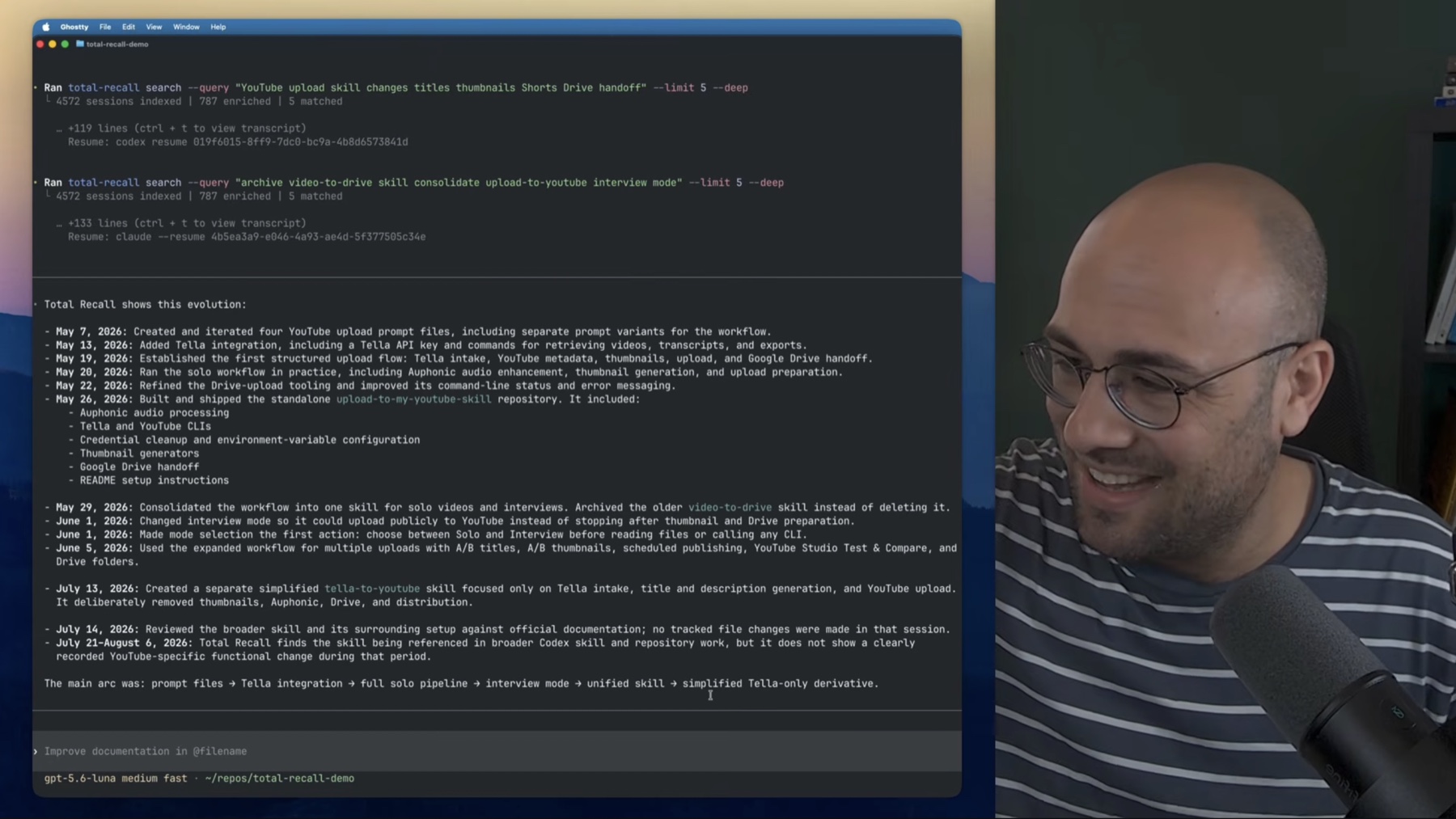
Alex 09:25 Sometimes I literally go in. For example, when I made Total Recall, the first versions of Total Recall, I went into the agent and said, "Run some query, look up what we talked about last Monday. I remember we said something about some client meeting, you remember?" I deliberately give it vague context. It surfaces some information and tells me, "Yes, I found this and that, this is the decision you made, and this is why you got confused just now, because there's another similar client," or something like that. Then I ask it, "Great, the test passed on my side, I got the information I wanted, but how was the experience for you?" I literally ask it, "Tell me, how was it for you to use Total Recall just now? What would you improve? What could make the experience easier for you?"
Alex 10:07 When I build tools for my agents, I really treat them as another user in the process. I work like this all the time when I build tools, including Token Optimizer. I really check. Okay, there are a few things Token Optimizer does in the background: it deliberately trims context that's unnecessary for that task and sets it aside, and the agent can pull it back when it needs it. So I ask it, "How is this for you? Is it okay? Did you get all the information you needed? Did we set aside something we maybe shouldn't have?" And I keep improving this way, among other things, in the agent's experience too.
Alex 10:49 And of course I also have very, very deterministic benchmarks in parallel. So I combine that, plus the user experience of the users, the people who actually use these systems, and that gives me the full picture. I think that's the way to develop products today.
Alex 11:04 I also think about products that don't consider the agentic aspect. There are still lots of products where I have to go into their UI to operate them, and lots of products are trying to integrate agents inside the product. Notion is one example. Notion has a great product. I've never used their agents, even though I have a subscription, and I just don't see the need. I prefer to use my own agents, who know all the context about me, from the whole range of tools I have connected. True, you can connect tools to Notion too, but I don't want to be dependent on Notion. I want to control the context.
Dekel 11:41 I think that's for another episode, but it's a strategic question for every technology company today: am I a closed ecosystem, building it all myself, or do I embrace openness? One of the [unclear] things that happened is with Salesforce's Slack. Today you realize that every agent and every action runs under Slack, because it's basically the interface they all use. Every team works in Slack in the end, and then you can tag Claude, or tag whatever coding agent you use, and it really has the context. A real teammate that can actually help, a kind of chief of staff. And we see that Slack understood: okay, we're the interface. These are such dramatic changes. But I think it really is the question every technology company faces, what it chooses to be.
Alex 12:40 Totally. That's a really important point. And context here, we've already started talking about the second point you raised. Context really is the most critical, most valuable resource there is today.
Alex 12:53 One of the things you'll also see as we get closer to massive adoption of agents: today it's obvious that when I get on a Zoom meeting, some agent of mine, or of the person I'm meeting with, joins and listens to the meeting. That's obvious, we don't look twice at it anymore, right? In the same way it'll become obvious that people who walk into a meeting with you just record it with some device. There are all kinds, [unclear], or glasses from Meta or whatever. They'll just record it, because it feeds their agents' context. It'll become so widespread. It has a lot of implications, and you can think about it in different directions, like, wait, what does that mean for us...
Dekel 13:41 There's a company called Pocket [as heard], [unclear] eight months, a physical product that records meetings and Zooms and so on. Within eight months they reached $100 million ARR. Pretty crazy. I think if I were in the US I'd probably buy it, with the hype, but it really is amazing. While we're on it, I'll give a small shout-out to an Israeli company, not a sponsor: Timeless. I'm a regular user, because it's great in Hebrew, and all the rooms and so on are very convenient for me.
Alex 14:16 So there's a chance that, I don't know Timeless's roadmap, but I'm pretty sure that a lot of what we're used to using only online today, a lot of companies, AI companies and all kinds of companies working on this context layer, like meetings, will also make physical products, or build some integration with physical products. It'll become the baseline. Why? Because this really is the point of our second brain, which is really our agent's brain. In the end, that's what makes the agent we have the most useful thing, and useful for us specifically.
Alex 14:55 As I said, I don't feel like using some agent in Notion right now, no matter which model runs there and no matter how high-quality they claim it is. I want my agent. I want the freedom to move from agent to agent. And by the way, that's how I work day to day, with lots of agents and lots of harnesses, different harnesses, including harnesses I built, including Devin, Claude Code, Codex, Droid and others. I jump between them all the time, and because they all have the same brain, my context is what lets me move from agent to agent, or from product to product, or from platform to platform, without worrying about vendor lock-in or that my data doesn't come with me.
Dekel 15:39 I think one of the hardest transitions back then, I'll say it, was the slight decline of ChatGPT at the time. ChatGPT knows everything about me. I've worked with it for two years, and suddenly I need to move to Claude, or to Gemini. People had a very, very hard time with that, and then suddenly you could extract the data and take it with you, all kinds of things like that. I think that's one of the biggest bottlenecks, one of the biggest difficulties, for people or even organizations that want to move from one coding agent to another. It learned me, it already knows me, it knows who I am, it remembers my previous conversations. It's not only the information I put in, it's also all the conversations and everything else it knows. So I think that's one of the difficulties.
Dekel 16:26 Let me try to describe how I work with agents, and then you can roast me. I went through it too: ChatGPT and so on, then Grok and so on, and then I made the move to Claude Code, which became my coding agent, with the brain in Obsidian. Back then I was at an excellent workshop by Tom Even [as heard], and we basically put in... I have Obsidian, which is the brain, and it's connected to Claude Code, and I put all the context in, organized into folders, by the agents. Super convenient. Today I feel that, for me at least, it's not enough. I wanted something connected to my phone too, because that's where I work, apropos your point.
Dekel 17:16 So I started checking out OpenClaw. At first I even had something with [unclear, possibly Manus] in Telegram. I connected OpenClaw, which is like my personal assistant. The problem with OpenClaw today, I think, is that it isn't strong enough. Many times it fails at things that are fairly basic. Say I was looking for flights and the like, and some of them it couldn't do, or conferences, and it doesn't have the context about me. Of course I can teach it, but, you know. The second thing I realized is that Telegram is a platform I'm not on. I only go in there for the agent. So I figured, fine, I'm moving it now to Base44's Superagent, and suddenly I have an agent in WhatsApp, and I can also add it to groups. The problem is that sometimes it has this... I won't pick a fight with Base44. Let's say that when I add it to groups, and people ask questions like "what's Dekel doing tomorrow?", the agent just says it, even though that person doesn't have that permission.
Alex 18:19 You're touching on very, very important points. First of all, one of the reasons I built myself a harness a long time ago, back when the buzz around OpenClaw was starting, when it was still a big thing that only a few people had noticed. One of the first things I understood: I [unclear] it, and there was no way I was touching it, because it was so exposed and unsafe. That was even before all the research came out showing how exposed and unsafe it was. Later Peter fixed it, sure, a lot of time has passed. I'm talking about January this year, January or February. That wasn't a time to touch these things.
Alex 19:02 So I built my own system, I built my own harness, entirely on my own architecture, not OpenClaw's. If I launched it today, it could really be one more of the harnesses competing with something like Hermes and OpenClaw. I call it Miss Chief. Miss Chief, like my Chief of Staff. I love wordplay. And I just use her. She's available to me everywhere: in Slack, in Telegram, in WhatsApp. She manages my calendars, I have four calendars, and emails of course, and Gmails. And really, as much of a cliché as it is to say, I don't even look anymore...
Dekel 19:42 Does she have her own tools? Like her own Gmail?
Alex 19:43 She has the tools she needs, including access to tools [unclear] so that she has access to the data. She has very, very clear permissions for which actions to take, and what not to do. Funny thing, she's on my WhatsApp, so I joke all the time that I wrapped her in something like 10 layers of bubble wrap before I let her out into the world. And I check her all the time, and she also has a kind of self-learning, an automatic system that checks how well she's functioning, fine or not fine, and fixes the relevant things. It runs every night, a kind of self-improvement.
Alex 20:20 And because she has perfect memory, because I built Total Recall and she uses Total Recall too, she remembers everything I ever said and asked for, and every reason a decision was or wasn't made, or what happened in some client meeting. In parallel she also knows everything my other agents did, what I worked on with Codex or with Claude.
Alex 20:44 And I can tell her, listen... I also have another tool called Outsourcerer, which is available on my GitHub. It's a tool that lets me just work in one session, and my agent in that session spins up a squad of agents in the background, from all kinds of harnesses. So it can, say, spin up Devin, which used to be Windsurf, spin up Droid, spin up Claude Code, Codex, or several parallel sessions of them, each with different models. I can run Kimi K3 somewhere, DeepSeek Flash [as heard] in another tool, and Fable in another tool, and it just runs off to work while it updates me in the overall session.
Dekel 21:25 So you're at the level of a kind of aggregator, for everything? Isn't it an aggregator?
Alex 21:29 Not an aggregator. These are real agents. Right now I have agents working on Codex, and one on Claude Code...
Dekel 21:35 And Devin?
Alex 21:35 In the background. I don't see these sessions. I just sit in front of one session. For example, I open an Opus session in Claude Code, I talk to it, and I tell it, "Okay, listen, now we need to build the platform. We're building a platform at 10X Company right now, I need it for such-and-such client, you remember what we talked about in that meeting? Go check the context." I don't even bother anymore. My prompts are like this: I just talk to it by voice, with Whisper, and I hardly bother explaining anything anymore, because it already has all the context. It knows exactly where to take each thing from.
Alex 22:06 And by the way, it also has very organized working methods. I have very organized plugins and skills for development work, for knowledge work, for whatever I need, so the agent knows where to take that from too. So I tell it, "Okay, yalla, spin up a squad, run it for us, start some loop. Your goal is such-and-such. Only call me if you need me." That's it, and it just runs. Now it updates me...
Dekel 22:34 And her, you talk to her on WhatsApp.
Alex 22:37 Yes, that's one example. I can talk to her on WhatsApp, or I can be in Claude Code, or I can work with Codex. It depends what I'm working on, but for example...
Dekel 22:45 You talk in Codex, and you talk in Claude Code, and you're talking to the same agent?
Alex 22:50 Those are two different divisions. I prefer Miss Chief, most of the time, to be on the work for 10X Company, things I do day to day, to help me run my world in a saner way. And sometimes I do tell her, "Check for a second, what is Codex doing on my computer right now?" And she goes and checks, for example. Then she can tell me, "That Opus session over there is asking for approval on some commit," because sometimes they do ask for approval on that, "and it's stuck on it." And I can say, "Okay, yalla, approve it," and it gets approved. I have full control now over my work environment, with agents running in the background.
Alex 23:32 And when I sit day to day, I usually sit with Claude or with Codex, and there too, it's one session. If you open my computer, you'll see several of these sessions, say, I don't know, five or six parallel sessions.
Dekel 23:45 What computer do you have, seriously?
Alex 23:47 M1 Mac.
Dekel 23:48 M1 Mac? [unclear]
Alex 23:50 Yes. I have a birthday soon, and I'm thinking maybe of treating myself to something newer, but meanwhile I manage.
Dekel 23:55 M1 Mac. Wow.
Alex 23:57 Yes, yes. So I open one session of, say, Claude, and what you see is only that session. What you don't see is that in the background it sometimes spins up 20 or 30 parallel sessions, each of them running with lots of subagents of their own.
Dekel 24:15 I assume what people will ask is how much this whole wonderful thing costs you a month.
Alex 24:20 It's really not as expensive as you think. First, of course I have the Claude Max subscription, for now still, because somehow... I know everyone is moving to Codex, and I use both all the time, but somehow Opus's orchestration, 4.8, I'm not touching 5, Opus's orchestration is really better in my eyes, somehow more intuitive than other orchestrators I've tried. So the most expensive thing I pay is $200 for Claude. I pay $20 for Codex, which is enough for a lot for me, even with all their resets. So far I usually don't get stuck on limits with Codex.
Alex 24:59 And I pay $15 for Devin, which was about the first subscription I took when I started this whole agent journey, because it has tons of models, and it also gives lots and lots of models for free. For example, right now, they extended this promotion, but say GLM-5.2, an amazing model, a crazy model, it's at Opus level, and they give it for free. So yes, you pay the $15, but then you don't get stuck on limits, and even if you've already used up your daily limits, you can keep running with GLM. So I manage to do a lot of work when I know which models to prioritize.
Alex 25:37 And Outsourcerer, one of the things it knows how to do is automatically look at the limits of all my subscriptions and all the harnesses I have on my computer. It knows how to say, "Ah, let's spin this one up here," and "Oh, wait, on OpenRouter there's a cool stealth model right now called Ox Alpha, it's completely free and it's probably better than Fable, we can run a few tasks there." And it'll also warn me and say, "Yes, but I'll run this task there and not that one, because they probably keep the data for training models." So even at that level, I can just trust what the agent does, and I try to gradually take myself out of the loop. To be in the loop as little as possible. That's the total opposite of what you'd have heard if you'd interviewed me a year ago, compared with where we are today.
Dekel 26:25 I want to take this somewhere. It feels to me like you've done a lot of architecture and strategy work, and I'm curious whether you can give listeners a tip on how to do it right. What we got used to with ChatGPT, for example, was simply "let's start working," it's my copilot. When we start thinking about agentic teammates, everyone has their own name for them. I heard someone who calls his [unclear], and Adam, and Chavi [as heard], whatever. Now I need to build an organization here, okay? And it already starts with guardrails: I need to tell it what it can do and what it can't do. There's a whole architecture of how this thing works. That sounds to me like more than choosing the coding agent and exactly which agent to use. There's a whole thing behind it that allows all of this to happen.
Alex 27:26 Totally. It wouldn't run otherwise. I say this to the agents too, like, "Don't treat me as if I'm another developer sitting next to you. I'm the architect, you're the developer. I'm the architect, I do the logic. I do the whole thing in the background, around you, that makes you work right, but I trust you to carry out the technical actions in the best way possible."
Alex 27:53 So what you're saying is very, very right. The logic and the architecture and how we do this thing in the background, including the context, is the most important thing you can do today, and not which tool to use and not which model to use, because in the end that's what will bring you the most value. If you built it in a way that's truly tailored to you, with all the parameters that are relevant to you, then even if you run with a relatively weak model, even Sonnet, okay? or something like that, you'll get really, really good results, say from your OpenClaw or another system you use.
Alex 28:31 And I think we're still at a stage where this is necessary, where you have to build it, and we're slowly, finally moving, like with Grok bot, X's Grok bot, to a state where you can create bots like this, agents like this, in two sentences. And then what's important to understand is actually the part of: okay, where does all this connect? How do they talk to each other? And do I even need a team? That's also a really important point.
Alex 29:03 I don't believe in these teams of agents. My agents work with hundreds of agents at any given moment, and they usually don't have... Apart from Miss Chief, who's my agent, Hermes-style, I don't have some agent I tell, "Okay, you're my chief of staff, you're my CMO." I think we're bringing a mindset that was maybe comfortable for us in the current world, already the old world, and I don't think it's the right mindset for future work with agents.
Dekel 29:35 Meaning, when you work, you have a certain goal? A certain domain? Certain skills, certain plugins, you have the tools and the architecture, the logic. And "this is what I expect you to do," yes? "That's your scope, run," like that?
Alex 29:51 Basically yes, as long as I have, again, as I said, the logic. For example, when I tell my agents to run, why do I already trust them so much? First, because development processes, for example, each have very, very precise evals, real gates. Before each stage, that specific eval has to run. If it doesn't pass, then I repeat the process and fix what's needed, and only if it passes, and there really are no regressions, or there's progress and we're moving forward, do I move to the next stage in the process, or hand the next stage to another agent in my squad.
Alex 30:29 So first, there are very, very serious gates of evals that are deterministic. That's terribly important. The more of that bubble wrap I talked about... I talked about it in the context of information security, but I mean it for everything in development too. As much determinism as possible inside our agentic processes is what will gradually allow us, okay, to step out a little bit. So that's one thing.
Alex 30:57 The second thing is context. The context I have, in the end, yes, everything goes into some kind of folder, but not only that. Yes, there's the context folder, which updates itself, and the agents work on it on their own, and every project has its relevant folder, and of course GitHub and all that. But there's also what's called Total Recall, which I created, which is the memory and the proactive context.
Alex 31:23 That means that instead of me having to tell my agent "check for a second" or "remember for a second what we did," it knows. It's like its number one rule: "If I'm missing something, if I don't remember something, before I ask Alex, I'll check everything, including Recall, and see if I have the information. Only if I don't have the information will I escalate it to Alex." And it also knows proactively. The system itself is proactive, so it knows, and it pulls these things, deterministically by the way. The search itself and the retrieval are deterministic, and it's also very, very token efficient, because it saves up to 97% of the tokens compared with, for example, systems like folders of markdown files. So it just surfaces things on its own and takes all the information it needs.
Alex 32:13 Just an example, from the development process itself. I do a lot of dogfooding on all my systems all the time: I develop them and I also use them all the time. For example, I needed to run some test to improve the system, and I thought about using some local model for a certain use case for Total Recall. I've been developing this thing for several good months now, since the start of the year, and I don't remember everything I ever tried or didn't try, and what worked and what didn't. Because only the things that work end up committed in git, you know.
Alex 32:48 So before I set off, I told it, "Listen, there's this model, it's really small and nice, let's run benchmarks on it." And it stopped me. It said, "No, wait, let me check in Recall for a second. Hey, we already ran these tests." That alone just saved me millions of tokens of serious work, just because someone said, "No, wait, why would we do that? We already did it, we saw it doesn't work, what you have now is much stronger than that, there's no need, let's move on." So suddenly there's a situation where I can trust it like a partner, like your work partner telling you, "Bro, leave it, no need."
Dekel 33:27 I think soon we'll have couples-therapy workshops for people and their agents. A crisis of trust, bro. You work with organizations. What do you see today as their main challenges?
Alex 33:47 The main challenges?
Dekel 33:48 Yes.
Alex 33:49 First of all, AI adoption today is very, very different, depending on which organization you walk into. In organizations that are naturally less technological, things move a bit more slowly, but on the other hand, that's also where you can prove the wow factor fastest. And I've actually seen that once people see the wow factor, adoption suddenly accelerates, adoption accelerates, [unclear].
Alex 34:21 And I really see that in large organizations, real enterprise, things also move slowly, but there the issue is a bit different, because there's much more of a people challenge. Really proving the value. Not just integrating AI into processes now, but proving the value to the people who have to work with these systems day to day: why they should do it rather than stay with their old way.
Alex 34:51 What's happening in large organizations today is that a lot of people run workshops, bring in workshops and private courses inside the organization for teams, tailored or not tailored. In the end, what happens is that there are a few champions. That always happens, in every field. There are always a few people in the company who are the most curious, who want it the most, who want to experiment and find where it helps them, and in the end they're the people who get the most value from these courses and workshops too. Most people, everyone else, just sit in these courses and go, "Okay, fine, nice, one more thing to remember." They see it as a chore.
Alex 35:32 That's something we understood relatively fast, and I'm actually glad we understood it fast, because at the beginning we were also doing private workshops, alongside all the adoption work we do, the custom builds and everything. And we realized there was an imbalance in expectations between whoever brings in the workshop, the team lead, for example, and most of the people on the team who come to do the workshop. For most of them, it's just another chore they have to do. They don't see value in it, they don't see it as something they need... Even if they learned something, right? It's not the workshop's [fault]. The workshop can be excellent. But they forgot about it the next day and went back to their previous way of working.
Alex 36:15 So first, we changed things so that we don't use a workshop format at all. Today we work in several forms, but one of them is close mentorship with the team. We work closely with the team leads and with a few champions we choose carefully, and we show them through use cases and specific goals they have, real goals the team has, KPIs they want to hit. We choose a few goals and work with them together to help them reach those goals, with that wow factor of AI, of agents, of context systems. And that's the start, right?
Alex 36:55 In parallel, and this can be in parallel or it can be a transition, we really help them build, and we build for them, their marketing brains or their go-to-market brains, the second brains they need, so that all the agents on the team get a single source of truth, the [unclear] source of truth for everyone. And from there you start, like building blocks, to build all kinds of other elements, and more elements, another agent, and another system, or another skill, or another plugin, and in the end these things connect in a very, very scalable way.
Alex 37:28 Because first, it gives the team very fast value. They immediately see, "I didn't do anything, but my agent already brings me my competitive research every Sunday morning in Slack, without me having to do anything, or ask anyone for anything." And people really tell us, we get pretty crazy feedback, and it's so fun to hear, "Wow, I didn't know this was possible." And suddenly, in those moments, you see the wheels turning and the lights starting to turn on for them. Also for people who are less technical, also for people you maybe wouldn't expect to initiate ideas, ideas pop up of what else they can do. "If this worked for me, and it saved me, and it saves me so much work every day, wow, maybe we'll do this too, and maybe we'll connect it to another system that creates some content based on it," for example, right? Suddenly things start to connect, and that's where the real transformation starts. Because in the end it always comes from the people.
Dekel 38:31 Amazing. Can you share one or two use cases of something you did with one of the organizations?
Alex 38:39 Yes, I can. There are lots of use cases. By the way, we also work with organizations not only in go-to-market but also on the operations side, but we usually put more emphasis on go-to-market and marketing. So of course the first things that always come to mind are all the content, right? Because in the end, with a lot of the use cases, marketers go straight to content. But I actually want to give a different angle, not specifically content creation, something else.
Alex 39:08 On one team we work with, at a very serious company in the cyber space, they had a content bottleneck. The content got created, but it was stuck in loops of endless feedback, endless feedback, endless approvals, which exists in every large organization.
Dekel 39:30 Totally.
Alex 39:31 For that matter, it isn't a large organization yet. It's a serious company, but it's a startup. But because the people sitting in the feedback loop were the CTO and the CEO and so on, there were a lot of nuances and a level of detail that really held up the marketing team in getting the materials out. So there were a few cool things we did there.
Alex 39:55 One of them: we built a system where the person writing the content just talks to their agent. Once they've written some blog post, they tell the agent which feedback is needed and who needs to give it, and the agent automatically does a setup in the background. The person who needs to give the feedback gets a message in Slack, and they also just talk to their agent, inside Claude or wherever they want. The system knows how to take the feedback, and also knows how to filter the feedback, and even knows how to do a kind of negotiation. If there's a conflict between several contradicting pieces of feedback from a few people, it knows how to tell him, "Hey, Mr. CEO, the CTO actually thinks this line is very important, because it creates a lot of value in terms of the product's value." Something like that, right?
Alex 40:46 That's one example. Later we also took this system several steps further. Now there's enough technical manpower to go over the content, several technical people who can take these pieces and review them, so there's less of the contradicting-feedback problem. But now we improved it so that the system automatically takes the blog that was written, for example, picks who's next on the list, in order, the next person in line to review it, and sends them a Slack. If it isn't done on time, they get another Slack. This whole thing is run by an agent that checks whether the feedback came in and passes the feedback to the content writer, and that's how it moves on its own, without you having to sit there and also feel awkward, like, "Okay, I have to remind and re-remind our IT person, or that developer who's very busy anyway, to give us feedback on the blog now," right? So that's just one example. I wanted to give an angle on things that usually aren't so common, because usually people really think about content writing.
Dekel 41:55 I think the beauty of it, and I think we did this with you too, is that you really need to write down everything you do today, your processes today, how you work today. There are a lot of things you don't think about. You want to write about things like content creation with AI, but there are so many bottlenecks you don't even think about, like, wait, 50% of my time goes to these approvals. If I take it back for a second, one of the most important things is to write down your processes. Because doing the work of mapping how we work today, there's a lot of room for delegation, there are things we can do. AI is a means in the end, and there are so many processes, and it's still organizational culture.
Alex 42:40 [unclear] I think AI is... We always say AI is the new electricity, that's how we see it at 10x. It's not a tool. Our tendency to call AI another tool holds us back in a certain way, because if you treat it as another tool, then sure, it's another computer, another app. But it isn't. It's the new electricity. So think about it: when electricity first arrived in factories that didn't have all the infrastructure for it, bringing in a few lamps isn't really what transformed them, right? They had to build the infrastructure, the wiring, the cables, the connections, the generators, everything needed for these things to run smoothly. And we're in a pretty similar period with AI. It just moves much, much faster, so we barely manage to understand it.
Alex 43:33 And what's most important here, in my view, is curiosity. Curious people, people who have this drive, who want to know, want to experiment, want to understand, are the people who are going to win big in this period. It's hard for me to describe how important it is. And in organizations themselves, if I were hiring people for my organization, my team, right now, that's probably the number one trait I'd examine to understand whether the person in front of me is someone I want to work with. Not necessarily over professional skill, of course, but it's really, really important, because in the end it also indicates a few other soft skills that I think help a lot too.
Dekel 44:23 What's your role today? It feels like today, working with agents, you have so many... At work, are agents a role, or...? What's our role as humans? What is the human in the loop?
Alex 44:38 Okay, that's a very, very good question. I really see myself, as I said, as the architect. I design the processes. I supervise from the side, from above, that the processes flow the way I wanted. Okay? But I'll tell you what I don't do. I don't micromanage, and I also don't do just pure delegation. The delegation is so that my agents can do the delegating. The agent I'm talking to will spin up Outsourcerer, for example, and delegate to all the other agents as it sees fit. I don't tell it how to delegate. I design the path. I'm the architect. That's how I see it.
Alex 45:24 I think communication is still a very, very decisive factor here: knowing how to communicate it, knowing how to say what you want, and knowing how to communicate it to the agent is very, very important. And of course, depending on the job, the role, the specific task we're working on, there are also elements of judging the outputs and looking at how well they actually fit.
Dekel 45:53 I'm asking because there's something very interesting here. Today I could take your videos from YouTube, and your blog, and your LinkedIn, and tell an agent, "Learn." There's a startup, [unclear], called Digital Twin [as heard], something like that, that raised about $20 million, where something can learn you and do things exactly like you. We're reaching an era where you can really take someone, even take a few people, and really take their knowledge. And that's an interesting point, because I think in the end we're the architects of this thing, and that's our role.
Alex 46:32 You know, I also have a skill called Alex Mode, which is exactly that. Since Total Recall, my tool, remembers everything, every session I ever had in every agent I ever had, all the context, I just told it, "Now do a serious overview of how I work, what we get stuck on more, what I..."
Dekel 46:57 You could raise $20 million right now.
Alex 47:03 Yalla, I'll think about it. You got me thinking. No, but really, this is something I recommend. Once you have that option, once your agent has access to the knowledge, I really, really recommend making some kind of mini-me, some skill or plugin or whatever, and then it becomes part of the loops that run. So, for example, the first judgment on some post that was written, or some landing page that was made, goes through Alex Mode automatically. Because what would Alex say about this? "Ah, well, she wouldn't... First of all, this is crooked and this is crooked, and this is copy that sounds like AI slop." "Ah, okay, fine, we'll fix it right away." That's just a general example, but it's not only that, it's in development too. I really recommend doing it.
Alex 47:51 One of the first skills I made, by the way, was an expert panel. Honestly, I barely use it today, but there are about 25 different experts in it, really in the style of Steve Jobs, Elon Musk, all kinds like that, and from all kinds of fields: writing, business, development, all kinds of experts. What happens is, say I needed to consult on something, it would run a team of subagents, choosing which of the experts are most relevant to the question I asked, and get some feedback. It's really nice. I recommend things like this, because it really opens your horizons. You still need to be there, obviously. For now, they still need us.
Dekel 48:46 Amazing. Alex, something to close with? We're already at 50 minutes, [unclear].
Alex 48:53 Wow. Okay. So to wrap up: Total Recall, the memory I talked about, is currently on a waitlist. You're welcome to sign up at total-recall.dev.
Dekel 49:05 I'll put it in the description too.
Alex 49:07 Yes. And it'll always be available in a super-generous free version for individuals, and a paid version for organizations and so on. But I really, really invite people to just play with it, because it's one of the things that simply changed my whole way of working.
Dekel 49:22 Amazing. Alex, I think this is one of the most meaningful episodes, because in the end the future is agents and humans. In the end we'll need to learn how to work with agents, and like we said, there's a huge infrastructure shift here, and the architecture of this thing. This wasn't another episode of "come learn about Hermes, about OpenClaw," and not only "come learn about the tools." There's plenty of that, there are great videos on YouTube about these things. I think this really was an episode about how to work right, how to talk to them, and how to prepare our infrastructure. Take one of the examples you gave here: I won't only talk with my team in Slack anymore, I'll talk with the agents too. It's going to be a whole part of communication, and it's a paradigm shift and a change in how I work today. I think it was very, very important and very practical, so thank you so much for that.
Alex 50:20 Thank you, Dekel, it was fun.
Dekel 50:22 It was really fun. Thanks again to GUTS, Harel's innovation hub. If you enjoyed this episode, I'll attach all the links here, to the tools we talked about and to all of Alex's tools and ventures. See you in the next episodes. Thank you so much.